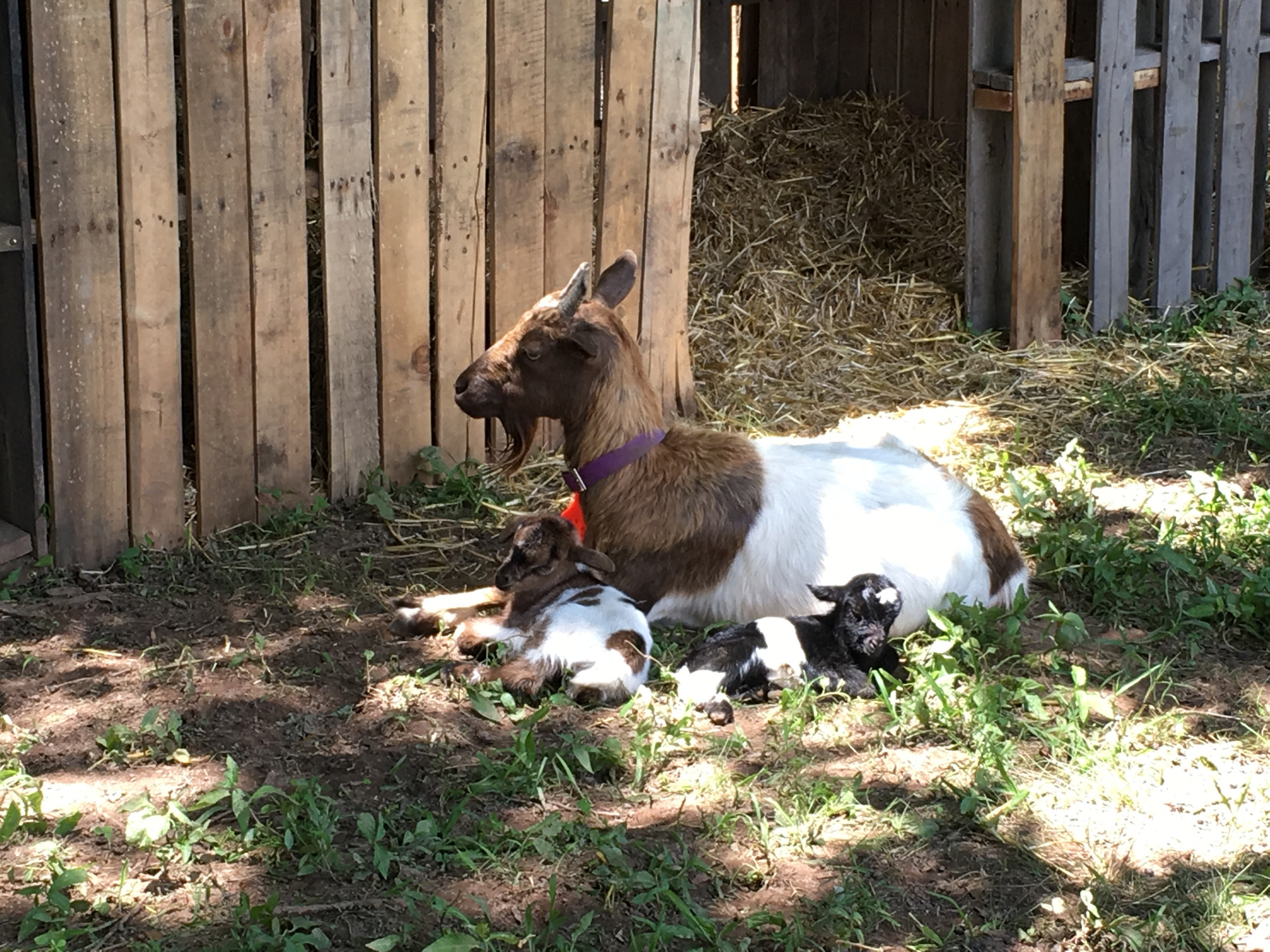
Myotonic Fainting Goats
Kathryn’s “So Cute” fainting goat farm was established summer of 2018. .
Our goat farm -So Cute- was named by our little Kathryn. Age 2. when trying to come up with a farm name we could not agree if it should be elegant or funny. Finally I asked little Kathryn, at less than 2 years old, what do you think about our goats? Her reply, "their so cute!!"


We are proud members of the International Fainting Goat Association and the Myotonic Goat Registry
We love our fainting goats and you will too!
What is a Tennessee Fainting Goat?
This breed of goat has several names- the most common are Myotonic, Tennessee Fainting, Nervous, stiff-legged. The names refer specifically to Myotonia congenita, a condition in which the muscle cells experience extended contraction when the goat is startled. Myotonia congenita is a mutation in the genes that affect the skeletal muscles which cause a shot term spasm in the muscles. This condition causes an uncontrollable stiffness that may cause the goat to remain "frozen" in the position that it was previously to the attack, or cause it to fall to the ground on its side. During an attack, which may last 5-15 seconds, the goat can often be picked up without any bending or movement occurring in its body. After a period of rest of about 30 minutes, a severe attack can be induced again. The temporary stiffness, related with these contractions, can cause the goat to stop moving, stiffen, and even fall down. The actual degree of stiffness may vary widely from goat to goat and is based on a number of factors, including age, species purity, and degree of fright. This condition occurs in many species, including humans. The goats do not truly "faint" in any sense of the word, as they never lose consciousness, just temporarily seize.
These domesticated goats are popular for many reasons. Classified as a meat goat, as opposed to a dairy goat, it can be raised for chevon (goat meat). Slightly smaller than standard breeds of the goat, which makes them easier to care for which is another reason why they make such wonderful pets. They are less likely to climb; therefore, less likely escapes. They have a high degree of muscularity, high reproductive rate and are not necessarily seasonal breeders. Historic documentation states that the original goats were a smaller goat weighing from 50-150 pounds. Fainting Goats have short and long hair and come in many different colors and patterns. The primary colors are black and white. These goats, male and female, can have horns or be poled. The eyes protrude from the eye sockets, as opposed to recessed eyes seen in other breeds. The profile is straight as opposed to the convex or "roman" profile.
History of the Goat
The goat was first domesticated in 10,000 BC and was the first animal to be used for its milk. Goats were brought to America by Columbus in 1493. A large group of goats is called a herd. There are over 450 million goats in the world and 210 different species. The largest population of goats is 170 million in China. Goats do not have teeth in their upper front jaw, but goats have 24 molars. Goats eat hay, grain, grass, and clover. Goats don't like to get wet and will seek shelter when it's raining. They are also very agile and some breeds can jump over 5 feet. Goat meat is lower in fat and cholesterol compared to beef, pork, mutton, and poultry. Both the male and female goats can have a beard. Coffee was first discovered by goat herders when they noticed the animals having an unusual amount of energy after eating coffee beans.
Male goats are called buck or Billy, and a castrated male is called a wether. A female is a doe or nanny. Baby goats are called kids. The life span can vary based on breed and gender. Fainting goats live 10-14 years up to 18 years. They can weight 50-190 pounds. The height is 17-25 inches at the withers. Gestation is 5 months or 150 days. The act of giving birth for a goat is called "kidding." Kids can be safely weaned at 12 weeks old.
History of the Fainting Goat
Reportedly in the 1880's there was a traveling farm laborer from Nova Scotia, Canada, by the name of John Tinsley. He was a quiet man with limited English who came through central Tennessee, Marshall County, and worked on the farm of Dr. H.H. Mayberry. Tinsley had with him four unusual, stiff goats, 1 buck and 3 does. It is unknown where Tinsley got these goats. After only a year, John Tinsley moved on looking for work. Dr. Mayberry, the county physician, purchased the goats from Tinsley to study their unique trait. Dr. Mayberry began to breed the goats and found that their kids got stiff and fell down as well. He concluded that this must be a different breed of goat and called them Tennessee Fainting Goats. All the Fainting goats here today are believed to have evolved from the four original goats brought here by John Tinsley. Dr. Mayberry sold the kids to nearby farmers. Local farmers liked the goats and their popularity grew.
Farmers began to appreciate them, and the numbers of "stiff," "nervous," or "fainting" goats increased. Farmers would put fainting goats in with their other goats or sheep herd for protection. If a predator such as coyote or wolf were to attack the herd, the sheep would run away, leaving the fainting goats behind during their immobilized state. The predator would focus on the easiest kill and give the rest of herd a chance to escape. This practice is no longer used.
According to the December 25, 1929 Naples Record, this strange phenomenon of goats "falling or fainting" was seen in all of the offspring of the pure-breed goats without exception.
The fainting was first described in scientific literature in 1904. In 1939 the goat was described as a "congenital myotonia". In 1996, the mutation in the goat gene that causes this muscle stiffness was discovered, several years after the equivalent gene was discovered in humans and mice.
During the 1950s, some Tennessee Fainting goats were taken to the hill country of central Texas. They were further selected for meat qualities, including larger size, and came to be known as "Wooden Leg" or "Myotonic" goats. Cross breeding these goats with other breeds became popular because of their kind disposition, muscularity, and hardiness.
By the 1980s, few of these goats remained in Tennessee and Texas. At this point the breed was considered rare and almost became extinct. The American Livestock Breeds Conservancy (now the Livestock Conservancy) stepped in and placed the breed on the endangered list. Over the years, the number of goats had increased enough to be placed on the threatened list.
In 2009, the Tennessee Fainting Goat was moved from threatened to the watch list. Although considered a meat goat, Tennessee Fainting Goats are sold more as domestic livestock or pets. Some believe that in the near future the larger "Texas Meat Goat" or "Myotonic Goat" will become a different breed from the smaller "Tennessee Fainting Goat" or "Myotonic goat". Over time the visible traits of these goats are changing such as: size, height, eyes protruding or bulging, ear shape, nose or face shape, and ability level to faint.
What to know when buying our goats
We
will disclose all known information on the goat, registered and
non-registered, goats that we previously purchased or raised on our
hobby farm. Date of birth and health records will be provided by our
farm. If it is a registered blood line goat we encourage you to
register your new goat. Transferring the registration will be the
buyer's responsibility. Application will be provided upon request.
- All goats have been vaccination for C,D &T and given a booster four weeks later.-Durvet Goat Vac C.D.-T
- Worming before sale and every spring/ fall.
- Copper Bolus Supplement - UltaCruze
- Trimmed hooves.
- Cash payments / receipts will be given at time of purchase for registered animals.
- Most put down a deposit of 50% to hold the animal till the sale / wean date.
- You
must purchase more than one goat if you don't already own goats.
Goats are social animals and do NOT do well alone. We typically do
discounts for multiple purchases.
- Transportation
of animals from our farm must be humane. We reserve the right to
refuse the sale of our goats at anytime. Hogtying and throwing our goats
in the truck of your car is NOT okay with us! Safe transportation is
required. Crate or carrier large enough for the goat, or stock
trailer/truck with cover will suffice. We will also consider the distance you have to
travel with your new goat.